Before the Tractor: How Haymaking Changed from Scythe to Machine
Before the tractor, haymaking relied on handwork and horse power. Learn how scythes, horse-drawn tools, and tractors changed field work and storage.
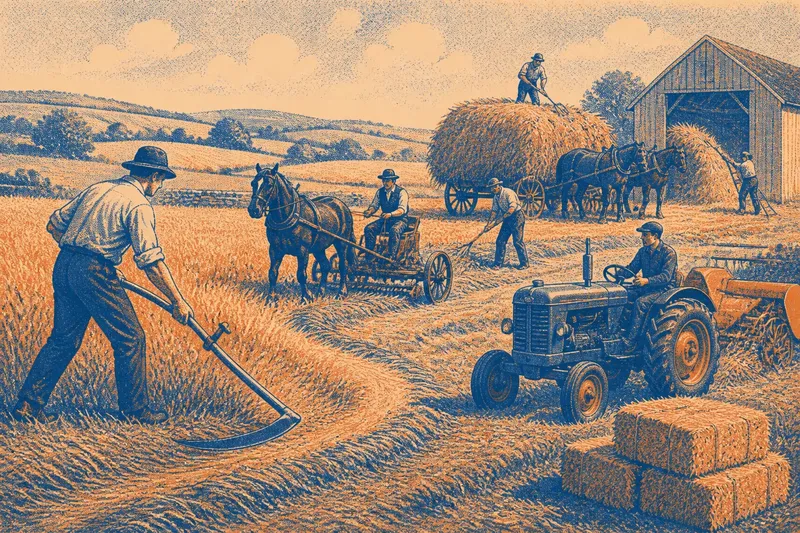
The most common mistake in comparing haymaking before the tractor with mechanized work is to call the older method simply slower. That misses the tradeoff: hand crews adjusted work around the crop and weather, while machines could cover more ground but needed suitable access, upkeep, and a plan for handling what they cut. Before tractors, haymaking changed through a gradual mix of skilled handwork and horse-drawn equipment.
Scythes made haymaking a crew-paced job
A worker using a scythe judged each stroke against the grass, slope, and obstacles. The cut grass fell in swaths, where it could be turned with forks or rakes as it dried. Workers then gathered it into heaps or windrows and hauled it to a stack or barn.
People judged readiness by handling the grass and watching its color, movement, and the weather. If a patch remained damp, they could leave it to dry while tending another area. This close attention helped a crew adapt, but every stage demanded physical work and coordination.
The tools shaped the crew’s arrangement. The person cutting needed room to swing; rakers followed to spread or gather the crop. A horse-drawn cart or wagon carried hay toward storage, but loading and unloading still took hands. Field work and storage were linked by a sequence of manual handoffs.
Horse-drawn tools increased output without removing handwork
Before tractors became common, horse-drawn mowers, rakes, and tedders changed how quickly some tasks could be done. A mower cut more grass in a pass than a scythe, while a rake or tedder reduced repeated hand work. Workers still had to judge drying conditions, gather the crop, load it, and stack it.
The new tools also brought their own demands. The operator watched the cutter bar, the ground, and the horses, while the rest of the crew handled the hay left behind. A horse mower could be useful on accessible ground, but it was less suited to awkward corners or fields where a team could not turn safely. Farms often combined machine work with hand tools rather than switching all at once.
Tractors changed the workday and the skills it required
Tractors brought more pulling power and made powered mowing and other field operations practical on a larger scale. Later equipment could gather and package hay in forms suited to mechanical handling, changing both field work and storage. A faster cut, however, did not make drying, hauling, or stacking automatic.
Mechanized work called for operators who could use and maintain equipment, along with a plan for moving hay to storage. Some tasks needed fewer people than before; other jobs shifted toward equipment handling and storage. Local judgment still mattered: someone had to read the crop, notice wet areas, and decide how to respond to changing weather.
How do the three approaches differ?
When does hand-led haymaking suit a field?
Hand work can suit a small area, uneven ground, or a narrow space that equipment cannot reach. It requires enough people to cut, turn, gather, and carry the crop without leaving hay unattended for too long.
What does horse-powered haymaking require?
Horse-drawn equipment calls for suitable animals, compatible implements, and a handler familiar with both. It can reduce repeated hand work, but the field must allow safe movement and turning.
What changes with tractor-based haymaking?
Tractor work can suit larger or more accessible fields and can move hay through some tasks more quickly. It also depends on equipment access, maintenance, a capable operator, and storage arrangements that can handle the crop.
How can you compare the approaches for one farm?
Check the field’s access and terrain, who is available to work, what tools or animals are on hand, and how hay will reach dry storage. If one method leaves the next task beyond the crew’s or equipment’s reach, consider a smaller work area or a different tool.
Compare the methods with a concrete field plan
Say a farm has a sloping meadow, a narrow entrance, two available workers, a scythe, a horse-drawn mower, and a barn with limited incoming space. These are invented details for illustration, not a report of a real farm. The workers first identify which sections the horse team can enter and turn in safely; if the slope or entrance makes that unsafe, they set those sections aside for hand cutting. They then check how much hay the pair can turn, gather, and carry while the cut grass dries. If the barn’s available space cannot accept more hay, they cut only the area they can move and store, leaving the rest for another suitable spell. The resulting plan uses the mower on accessible ground, hand tools on suitable smaller sections, and limits cutting to the amount the crew can handle.
- Check whether the entrance and turning area allow a horse team or machine to pass; if they do, use the suitable equipment, and if they do not, use hand tools or leave that section uncut.
- Check the slope and ground for safe footing; if the team or machine can work there safely, proceed cautiously, and if not, choose hand work where appropriate or exclude the area.
- Check the number of available workers and the tasks they can cover; if they can turn, gather, and haul the cut grass, plan that area, and if not, cut a smaller area or arrange more help.
- Check the grass for dampness and watch the weather; if it is ready to gather and conditions allow, move it toward storage, and if it remains damp or rain threatens, adjust the order of work rather than gathering wet hay.
- Check the condition of the scythe, horse-drawn implement, or tractor equipment before use; if it is serviceable and the operator knows it, use it as intended, and if not, repair it or choose a tool that is ready.
- Check the hauling route and the barn space available; if both can take the planned crop, continue with that area, and if either is constrained, reduce the amount cut or arrange an alternative dry storage place.
For a useful comparison, start with where the hay will be kept dry and work backward to hauling, gathering, and cutting. The approach should suit the field and the available tools, but it also has to fit the crew’s ability to move the crop from the meadow into storage. Before using machinery or working with horses, follow equipment instructions and local safety requirements; consult a qualified professional where the work exceeds your training.
Before the tractor, haymaking’s pace came chiefly from people and horses; mechanization shifted more of the work toward equipment and its operation. That history offers a practical distinction: choose tools for the ground they can safely reach, and cut only what the available crew can turn, gather, and store in suitable conditions.